


Two statuses, one question
What HEPSS is?
HEPSS, which stands for High Executive Possessing Specialist Skills, is a Gibraltar tax status for senior executives recruited from outside Gibraltar by a Gibraltar employer. It is governed by the High Executive Possessing Specialist Skills Rules 2008. It exists to help Gibraltar businesses bring in senior people whose skills are not available locally, and it does so by charging Gibraltar income tax on a fixed amount of the executive’s salary, however high the salary is.
HEPSS is tied to a job. The employer is central to the application, the certificate names the employer and the post, and the status lasts only while the qualifying employment continues. That is the main difference from Category 2 status, which is for individuals of substantial wealth who are not taking up local employment.
Who qualifies
To qualify, the individual must take up a high executive or senior management position with a Gibraltar employer, earning more than £160,000 a year in Gibraltar.
The individual must possess specialist skills that are not available in Gibraltar and that will promote and sustain economic activity of particular value to the territory. In our experience the roles are senior positions in gaming, insurance, funds, fintech and other financial services businesses, and in the firms that serve them.
The individual must not have been resident in Gibraltar, or working in Gibraltar, in the 36 months before the year of application. The Minister with responsibility for finance may waive this requirement (rule 3, HEPSS Rules 2008).
The individual must have approved residential accommodation in Gibraltar for their exclusive use, bought or rented.
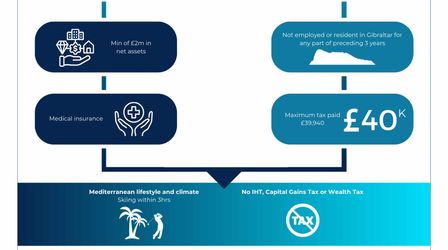
There is no wealth test. HEPSS tests the role, the salary and the skills, not the executive’s net worth.
How the tax works
A HEPSS individual is charged to Gibraltar income tax on exactly £160,000 of the income from the qualifying employment, under the gross income based system, however much that remuneration is (rule 7, HEPSS Rules 2008). At the rates in force since Wednesday 1 July 2024 (LN 2024/138) the annual tax is £39,940, the figure the Income Tax Office gives on its qualifying individuals page; in the first and last year of assessment it is charged by complete or part calendar month of the certificate’s validity. Remuneration from the qualifying employment above £160,000 is not charged, and £160,000 is charged even where the actual remuneration falls below it in a year.
Any other assessable income is charged in full, with the £160,000 counted in fixing the rate (rule 8). Income that Gibraltar does not tax in any case, such as bank interest and dividends from companies quoted on a recognised exchange, remains untaxed.
The Gibraltar tax year runs from 1 July to 30 June. There is no advance payment of tax and no refundable deposit under HEPSS, unlike Category 2.
Applying
The application is made by the employer in writing to the Finance Centre Director, with the individual, on the Finance Centre’s HEPSS application form and checklist. The Director issues the certificate where the Minister with responsibility for finance is satisfied that the conditions are met (rule 3), and approves the accommodation. The employer’s standing and the role are examined as well as the individual. The application fee is £1,264 (LN 2026/295, in force from Saturday 1 August 2026).
Approved accommodation must be in place for the application to complete; rented accommodation qualifies. No official processing time is published.
Residence in Gibraltar
HEPSS is a tax status. The right to live in Gibraltar is a separate matter. Since Tuesday 14 July 2026, when the Residency Regulations 2026 came into operation, a HEPSS executive takes a residence permit under the Regulations as a separate step, on the employment route: a contract of at least one year with a licensed or regulated Gibraltar employer, accommodation bought or rented for at least twelve months, vetting in the country of last habitual residence, and an age of 55 or under, which the Chief Minister may waive for skills important to Gibraltar (regulation 7). The executive’s spouse or civil partner, children under 18 and children over 18 in full-time education take residence under the Regulations as family members, subject to vetting and, for a spouse or civil partner, a deposit equal to one year’s social insurance (regulation 23). Residence gives the holder and immediate family access to healthcare through the Group Practice Medical Scheme and to schooling, according to the Government’s residency guidance.
British, EU, EEA and Swiss nationals need no work permit to take up the employment. Other nationals do: the employer applies to the Department of Employment, and approval in principle is needed before the residence application.
What HEPSS does not do
HEPSS does not make the executive tax resident in Gibraltar for the purposes of a double taxation agreement, and it does not protect them from being tax resident somewhere else. Tax residence in Gibraltar follows presence: 183 days in a tax year, or more than 300 days over three consecutive years (Income Tax Act 2010). It is evidenced by a residence certificate from the Income Tax Office, issued on the evidence set out in its guidance last updated Wednesday 16 September 2026. The UK-Spain international agreement on taxation regarding Gibraltar says in terms that the HEPSS regime does not of itself constitute proof of tax residency in Gibraltar for the purposes of that agreement.
HEPSS imposes no minimum number of days in Gibraltar. The executive’s position in any other country where they spend time is a question for advisers there.
HEPSS does not survive the employment. The certificate names the employer and the post, so a change of employer or role requires the position to be looked at again, and the status can lapse in between. The residence permit is revoked 16 weeks after notice of termination of the employment unless a new qualifying contract is in place (regulation 19). Moving to Category 2 status when the employment ends is not automatic: rule 4 of the Qualifying (Category 2) Individuals Rules 2004 excludes anyone who has been employed in Gibraltar in the preceding five years, so the move requires the Finance Centre Director’s waiver.
HEPSS or Category 2
If your income comes from a Gibraltar job at more than £160,000 a year and you bring skills the territory needs, HEPSS is the status. If your income comes from your wealth rather than from a Gibraltar job, Category 2 is the status, and following the changes announced on Thursday 18 June 2026 a new Category 2 applicant must have a net worth in excess of £5 million. In practice the two are alternatives: Category 2 ordinarily excludes anyone who has been employed in Gibraltar in the preceding five years and permits local employment only with the Finance Centre Director’s consent (rules 4 and 5 of the 2004 Rules), while HEPSS exists for the employment itself. Our comparison page sets the two side by side.
Frequently asked questions
Does HEPSS have a wealth test?
No. HEPSS tests the role, the salary and the skills, not the executive’s wealth.
Is salary above £160,000 taxed?
No. Tax is charged on exactly £160,000 of the income from the qualifying employment, so remuneration from that employment above £160,000 is not charged. Other assessable income is charged in full.
How much tax will I pay?
At the rates in force since Wednesday 1 July 2024, £39,940 a year on the qualifying employment income, charged by calendar month in the first and last year, plus tax in full on any other assessable income.
What happens if I change jobs?
The status is tied to the qualifying employment. A new role with a new or the same employer needs to be considered afresh, and the status can lapse in between.
Can my family come with me?
Yes. Your spouse or civil partner, children under 18 and children over 18 in full-time education take residence under the Residency Regulations 2026 as family members.
Does HEPSS make me tax resident in Gibraltar?
No. Tax residence in Gibraltar depends on days spent here and is evidenced by a residence certificate from the Income Tax Office. HEPSS is a tax status, not proof of residence.
How long does it take?
Neither the Rules nor the Finance Centre’s checklist states a processing time. The application is decided on a complete application from the employer and the individual.
What does HEPSS cost?
An application fee of £1,264 (in force from Saturday 1 August 2026), the annual tax, the cost of approved accommodation, and the residence permit fees under the Residency Regulations 2026: £250 per person on application and £20 on renewal, a deposit equal to one year’s social insurance where a spouse or civil partner is included, and a £70 work permit fee for nationals who need one (Government residency portal, updated Wednesday 12 August 2026).
How Hassans can help
Hassans International Law Firm Limited advises employers and executives on HEPSS: assessing whether the role and the candidate qualify, preparing and submitting the application, liaising with the Finance Centre Director, securing approval of accommodation, and completing the residence permit that follows. We also advise employers on recruiting under HEPSS and on the position when a HEPSS executive changes role or leaves.
For the comparison with Category 2, see our Category 2 or HEPSS page. Contact our Private Client team on +350 20079000 or at info@hassans.gi.
Meet the Private Client Team




Latest News & Insights For Category 2 or HEPSS: which Gibraltar status fits

Three Hassans lawyers named Passle Thought Leaders for 2026.
Congratulations to Anna Barnett, Matthew Torres and Selwyn Figueras who have been named Passle Thought Leaders for 2026, joining a select...

Gibraltar’s New Residence Criteria: What the Reform Means for Employers, Applicants and Existing Residents
KEY FACTS New residence applications are assessed against published criteria from 17 June 2026Existing Gibraltar identity card holders...

Safe, Stable, Secure: What HNWIs Should Know About Gibraltar.
Safety is a premium in today’s world. Geopolitical tensions in the Middle East have shown that security is fragile, and HNWIs have taken...

The Enduring Appeal of Gibraltar for Global Estate Planning.
Contributing recently to Legal 500’s “An interview with…” provided an opportunity to reflect on what continues to distinguish Gibraltar...

AI, Liability, and the Legal Definition of Persona
Artificial intelligence is driving a new category of legal risk centred on responsibility, attribution, control, and definition....

Gibraltar – the ideal home for multi-jurisdictional wealth structuring
The UK private client landscape is currently defined by significant fiscal recalibration and a fundamental shift in the taxation of...

Gibraltar’s Residency Rules: new context from answers to questions in the Gibraltar Parliament
Update - June 2026 The criteria anticipated in this article have now been published by the Government. This post is retained for context....

Solid as the Rock: Gibraltar, a safe haven for individual and corporate wealth.
Investors today are paying for safety. The record highs in gold and silver described in the below-linked BBC article reflect deep unease...

Pensioner Tax Increase in the Spotlight – How Does Gibraltar Compare?
With “pensioner tax increase” trending across the UK today, many are reacting to reports of rising tax burdens on retirees. Concerns...

Trading Blows – Embracing Beneficially
The World continues to recoil over President Trump's self-titled Liberation Day (2 April 2025), where new tariffs were imposed in a...

Trusts v Foundations – Factors to consider when deciding on either vehicle.
Broadly speaking, in a private client situation where you’re looking at helping to structure an asset as part of a client’s overall...
CAT 2 & HEPSS Tax Status – benefits and requirements (infographic)
Update - June 2026 The criteria anticipated in this article have now been published. Read our full analysis of the new residence rules:...
A full service law firm
With Hassans by your side, you can be sure of the best advice, from the right person for the job, in all areas of legal practice in Gibraltar.
