


Who this guide is for
This guide is written for a UK resident who is considering moving to Gibraltar and wants to understand the whole picture before taking advice: which UK questions need settling before you leave, how residence in Gibraltar is obtained, what Gibraltar taxes once you are here, and the order in which the steps should be taken. It sets out the Gibraltar side in full and names the UK questions that need to be settled with a UK adviser before anything is committed, because most of the questions we are asked by people arriving from the UK are questions of UK law.
It is a general guide and not advice. Hassans advises on Gibraltar law; nothing on this page is advice on the law of the United Kingdom. The UK rules changed substantially on Sunday 6 April 2025 and the Gibraltar residence rules changed in June and July 2026, and both continue to move. Figures are those in force at the date shown at the top of this page.
Why Gibraltar
Gibraltar is a British Overseas Territory at the southern tip of Spain, self-governing in its tax and domestic affairs, with English law, English as the official language, sterling as the currency, and a legal and regulatory system that a UK adviser will recognise. It has no capital gains tax, no inheritance tax, no wealth tax and no VAT. Income tax is charged at rates that produce an effective overall rate not exceeding 25 per cent (Rates of Tax Rules 1989 as amended; EY Gibraltar Budget note of Tuesday 14 July 2026), and two special statuses, Category 2 for individuals of substantial wealth and HEPSS for senior executives, cap the tax payable. The territory has direct flights from London, and the treaty between the UK and the EU on Gibraltar, provisionally applied from Wednesday 15 July 2026, gives Gibraltar residents fluid movement into Spain and the Schengen area.
The UK questions to settle before you move
Most of the questions a UK resident brings to us are questions about the United Kingdom: when UK residence ends, what UK tax follows a person who leaves, and what happens to UK property, pensions and investments. Those are questions of UK law. Hassans advises on Gibraltar law, and the right order is to have them answered by a UK adviser before anything in Gibraltar is committed to, because the answers decide the timing of the move and sometimes whether it should be made at all. The questions are these.
When UK residence ends. Moving to Gibraltar does not by itself end UK tax residence. The UK applies its own statutory test, which turns on days spent in the UK and the ties kept there, and it has rules for the year of departure. Your UK adviser will tell you how many days you can spend in the UK, which ties matter in your case, and whether the year you leave can be split. Those limits then shape how much time you can spend in the UK once you are living here.
Inheritance tax. The UK changed the basis on which worldwide assets fall within inheritance tax in April 2025, and a person who leaves the UK may remain within it for a period after leaving that depends on their years of UK residence. This is the question that matters most to many of the people who come to us. Your UK adviser will tell you how long that period is in your case, which is a reason to plan the move early and to keep records of residence from the first year.
UK income and gains. Once you are non-resident the UK continues to tax some income and gains with a UK source, UK property in particular, and has rules for gains realised by a person who later returns. Which of your assets remain within UK tax, and whether any gain should be realised before or after you leave, is a question for your UK adviser. The Gibraltar position on the same assets is set out below.
Pensions. How the UK taxes a UK pension paid to a Gibraltar resident, and whether a transfer to a Gibraltar scheme is possible or sensible, are questions for a UK pensions adviser. The Gibraltar position is this: Gibraltar charges pension income wherever it arises (Income Tax Act 2010, section 11), taxes pension income from an approved scheme at zero in the hands of a person aged 60 or over, and gives relief for tax paid elsewhere on the same income.
A UK home. Keeping a home in the UK affects your UK residence position and is one of the matters your UK adviser will consider. On the Gibraltar side, Category 2 and HEPSS require approved accommodation in Gibraltar for your exclusive use whether or not you keep a home elsewhere.
The UK-Gibraltar double taxation agreement
The UK and Gibraltar signed a full double taxation agreement in 2019. It has applied in the UK since Monday 6 April 2020 and in Gibraltar since Wednesday 1 July 2020. It does three things for an individual moving between the two.
It decides which of the two you are resident in for treaty purposes when both claim you. The tie-breaker looks first at where you have a permanent home; if you have one in both, at where your centre of vital interests lies (family, work, social and economic ties); then at habitual abode; and finally at agreement between the two tax authorities. How those tests apply to a particular person is a question for advisers on both sides.
It allocates taxing rights between the two. In outline, income and gains from property stay with the territory where the property is, pensions may be taxed where they arise, and dividends, interest and royalties are dealt with by specific articles. How the treaty applies to a particular person’s income is a question for advisers on both sides.
It provides for exchange of information and mutual assistance in the collection of tax between HMRC and the Gibraltar Income Tax Office (Articles 25 and 26).
One point should be understood clearly. A Category 2 or HEPSS certificate is a Gibraltar tax status; it is not a certificate of treaty residence. To rely on the treaty you must be resident in Gibraltar under Gibraltar’s own rules, which turn on days spent here, and the Income Tax Office issues a residence certificate on evidence of presence. Its guidance, last updated Wednesday 16 September 2026, sets out what that evidence is. The permanent home and centre of vital interests tests belong to the treaty tie-breaker, which applies only where both territories claim you.
Becoming resident in Gibraltar
There are two separate questions: the right to reside, and tax residence. The Government of Gibraltar announced new residence criteria on Wednesday 17 June 2026, and the Residency Regulations 2026 came into operation on Tuesday 14 July 2026, applying to applications made from Monday 6 October 2025. The routes for a person arriving from the UK are these.
Category 2 status is the route for individuals of substantial wealth who are not taking up local employment. Following the changes announced on Thursday 18 June 2026, a new applicant must have a net worth in excess of £5 million (a Finance Centre condition applied through its June 2026 application checklist), must have approved residential accommodation in Gibraltar for their exclusive use, must not have been present in Gibraltar for more than 183 days in any one of the five preceding years nor an average of more than 90 days in any three of them and must not have carried on a trade, business or employment here in that period, must hold private medical insurance, and pays an application fee of £5,000 (in force from Monday 22 June 2026). Tax is assessed on the first £118,000 of assessable income only, with a minimum of £37,000 and, at current rates, a maximum of £42,380 a year (Income Tax Office page, undated), and an advance payment of tax equal to the maximum is made on application and refunded on surrender. There is no minimum number of days to spend in Gibraltar, but tax residence elsewhere is a separate question, and a Category 2 individual who spends most of the year in the UK may well remain UK resident under the UK’s own test, which is a question for a UK adviser. The full requirements are on our Category 2 page.
HEPSS status is the route for a senior executive taking up employment with a Gibraltar employer at a salary above £160,000, with skills the Government considers of particular economic value. Tax is charged on £160,000 of income only. The employer is central to the application.
Ordinary employment with a Gibraltar employer is a route in its own right under the Residency Regulations 2026, assessed against published criteria that include a qualifying salary, an established and licensed employer, suitable accommodation and, subject to the Chief Minister’s discretion, an age of 55 or under. The Regulations also provide routes for the self-employed, students, Crown servants and family members.
The self-sufficiency route that previously allowed a person of independent means, including a UK pensioner, to take up residence without employment is not among the routes in the Regulations. For a person of means who is not taking up employment, Category 2 is the route the Government describes as carrying residence; the Regulations themselves do not set out the permit mechanism for Category 2 holders, and the Government has confirmed that a person who ceases to hold the status has no right to remain on that basis. Persons who held a valid Civilian Registration Card or Permit of Residence on Monday 6 October 2025 are not affected.
Tax residence in Gibraltar, which is what engages the Gibraltar tax system and the treaty, follows presence: 183 days in a tax year (1 July to 30 June), or more than 300 days across three consecutive years.
What Gibraltar taxes, and what it does not
Gibraltar levies no capital taxes. An ordinarily resident individual is taxed on worldwide income from employment, self-employment, trade, property and pensions, under either an allowance-based system or a gross income based system, at rates that produce an effective overall rate not exceeding 25 per cent (Rates of Tax Rules 1989 as amended). The tax year runs from 1 July to 30 June.
There is no capital gains tax (with one exception: since Thursday 1 January 2025 profits on sales of property by a person holding five or more taxable properties are taxed as income), no inheritance tax or estate duty, no wealth tax, no gift tax and no VAT. Dividends from companies quoted on a recognised exchange, bank interest and most other passive income are not taxed. Pension income from an approved fund is taxed at zero for a person aged 60 or over.
Two qualifications apply to new arrivals. In the Budget of Tuesday 28 June 2022 the Government announced a charge on the savings, pension and other passive income of non-Gibraltarian residents who hold neither a Category 2 nor a HEPSS certificate and are not in genuine third-party employment; the statuses are relevant to that charge, and its enacted form should be confirmed with the Income Tax Office. And stamp duty is payable on the purchase of property and on mortgages, at rates that rise with value (Stamp Duties Act, consolidated to Monday 23 December 2024).
Companies pay corporation tax at 15 per cent on income accruing in or derived from Gibraltar.
The order to do things in
The sequence matters, because some steps depend on others and some have UK consequences if taken too early or too late.
First, take UK advice on your own position before anything else, on the questions set out above: when your UK residence ends, how long UK inheritance tax follows you, which UK income and gains remain taxable, and your pensions.
Second, decide the Gibraltar route. For most people arriving from the UK without local employment, that is Category 2, and the net worth, accommodation and insurance requirements should be checked against your circumstances before anything is committed.
Third, secure accommodation. Category 2 and HEPSS both require approved accommodation for your exclusive use, and the application cannot complete without it. Rented accommodation qualifies.
Fourth, apply. The Category 2 application goes to the Finance Centre Director with the documents on the Finance Centre’s June 2026 checklist, including a reliance letter from a Gibraltar regulated intermediary, and the Finance Centre Director decides. Residence documentation follows the certificate.
Fifth, leave the UK on the footing your UK adviser has settled, keep a day count from the first day, and register with the Gibraltar Income Tax Office. Obtain a Gibraltar tax residence certificate once you can evidence residence here, because that certificate, and not the Category 2 certificate, is what the UK and others will ask for.
Sixth, deal with the things that follow: UK property arrangements and the non-resident landlord scheme, notifying UK pension providers, bank and investment accounts, wills in both jurisdictions, and private medical insurance, which Category 2 individuals must hold throughout.
Frequently asked questions
Can a UK citizen move to Gibraltar?
Yes, with a residence permit. A British citizen who is not a Gibraltarian needs no visa or work permit, but needs a residence permit to live here; without one the stay is limited to 90 days in any 180. Since Tuesday 14 July 2026 a new resident qualifies under the Residency Regulations 2026 (employment, self-employment, study and family routes) or under Category 2 or HEPSS. The former self-sufficiency route is not among the routes in the Regulations.
Does Category 2 status make me tax resident in Gibraltar?
No. Category 2 is a tax status that caps what Gibraltar charges. Tax residence in Gibraltar depends on days spent here; if both Gibraltar and another country claim you, the treaty tie-breaker decides, and that is a question for advisers on both sides.
Do I have to spend a minimum number of days in Gibraltar as a Category 2 individual?
Gibraltar does not impose one. The Gibraltar residence certificate rules do in practice, because too few days here leaves you unable to evidence residence. The number of days you may spend in the UK is a question for your UK adviser.
Is my UK pension taxed in Gibraltar?
Gibraltar charges pension income wherever it arises, but taxes approved-scheme pension income at zero for a person aged 60 or over and gives relief for tax paid elsewhere. How the UK taxes the pension is a question for a UK adviser.
Can I keep a home in the UK?
Gibraltar does not prevent it; Category 2 and HEPSS require approved accommodation here for your exclusive use in any event. What a UK home means for your UK residence position is a question for your UK adviser.
What does Category 2 cost?
A £5,000 application fee (in force from Monday 22 June 2026), an advance payment of tax of £42,380 refunded when the status is surrendered, annual tax of between £37,000 and £42,380 at current rates, private medical insurance, and the cost of approved accommodation.
How long does it take?
No official processing time is published. In our experience, finding accommodation and completing the UK-side planning take longer than the application itself.
How Hassans can help
Hassans has advised individuals and families moving to Gibraltar since 1939 and is the largest law firm in the territory. Our private client and tax teams handle the Gibraltar side of the move in full: Category 2 and HEPSS applications, residence permits, accommodation, tax registration and residence certificates, trusts and structuring, wills and estate planning. We work alongside your UK advisers on the UK side, and where you do not have one we can introduce you to firms we work with regularly.
Contact our Private Client team on +350 20079000 or at info@hassans.gi.
Related pages
Meet the Private Client Team




Latest News & Insights For Moving to Gibraltar from the UK: a guide for UK residents

Three Hassans lawyers named Passle Thought Leaders for 2026.
Congratulations to Anna Barnett, Matthew Torres and Selwyn Figueras who have been named Passle Thought Leaders for 2026, joining a select...

Gibraltar’s New Residence Criteria: What the Reform Means for Employers, Applicants and Existing Residents
KEY FACTS New residence applications are assessed against published criteria from 17 June 2026Existing Gibraltar identity card holders...

Safe, Stable, Secure: What HNWIs Should Know About Gibraltar.
Safety is a premium in today’s world. Geopolitical tensions in the Middle East have shown that security is fragile, and HNWIs have taken...

The Enduring Appeal of Gibraltar for Global Estate Planning.
Contributing recently to Legal 500’s “An interview with…” provided an opportunity to reflect on what continues to distinguish Gibraltar...

AI, Liability, and the Legal Definition of Persona
Artificial intelligence is driving a new category of legal risk centred on responsibility, attribution, control, and definition....

Gibraltar – the ideal home for multi-jurisdictional wealth structuring
The UK private client landscape is currently defined by significant fiscal recalibration and a fundamental shift in the taxation of...

Gibraltar’s Residency Rules: new context from answers to questions in the Gibraltar Parliament
Update - June 2026 The criteria anticipated in this article have now been published by the Government. This post is retained for context....

Solid as the Rock: Gibraltar, a safe haven for individual and corporate wealth.
Investors today are paying for safety. The record highs in gold and silver described in the below-linked BBC article reflect deep unease...

Pensioner Tax Increase in the Spotlight – How Does Gibraltar Compare?
With “pensioner tax increase” trending across the UK today, many are reacting to reports of rising tax burdens on retirees. Concerns...

Trading Blows – Embracing Beneficially
The World continues to recoil over President Trump's self-titled Liberation Day (2 April 2025), where new tariffs were imposed in a...

Trusts v Foundations – Factors to consider when deciding on either vehicle.
Broadly speaking, in a private client situation where you’re looking at helping to structure an asset as part of a client’s overall...
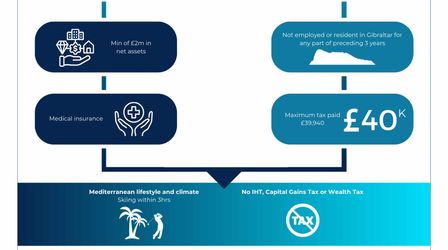
CAT 2 & HEPSS Tax Status – benefits and requirements (infographic)
Update - June 2026 The criteria anticipated in this article have now been published. Read our full analysis of the new residence rules:...
A full service law firm
With Hassans by your side, you can be sure of the best advice, from the right person for the job, in all areas of legal practice in Gibraltar.
