

In 2009, the first practical blockchain as a public ledger, the Bitcoin network, was released by Satoshi Nakamoto. Since then, there have been continuous developments in the blockchain space. More specifically, and importantly, the Ethereum network launched in 2015, marking the first widespread implementation of smart contracts for programmable applications. This release triggered a paradigm shift, setting the stage for an era of decentralised applications, and with this, asset tokenisation.
Tokenisation of Real-World Assets
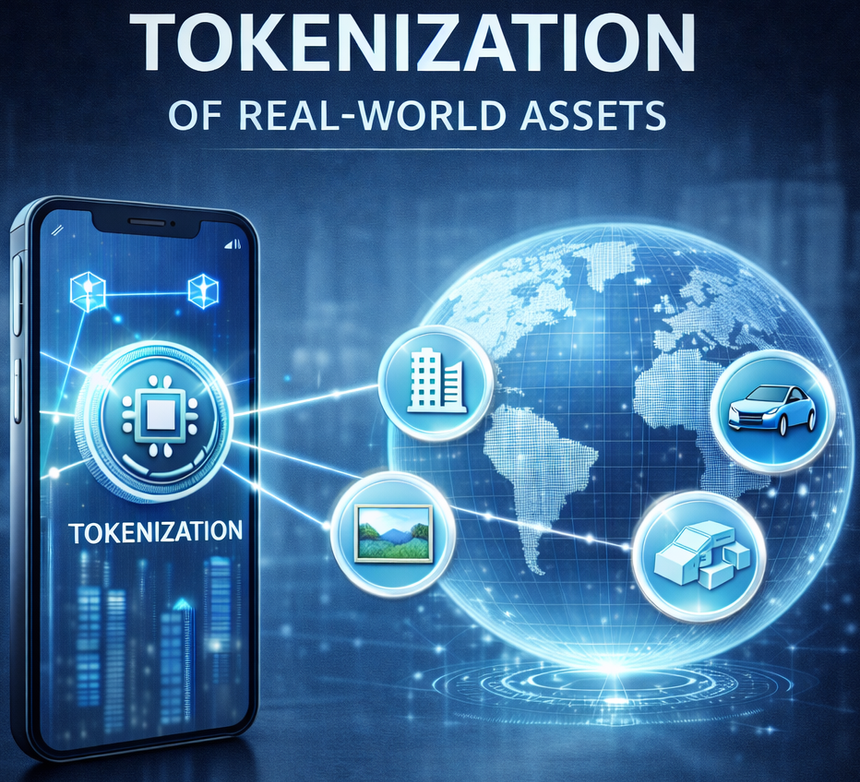
In its simplest form, asset tokenisation converts ownership rights in a physical, intangible, or digital asset into a token recorded on distributed ledger technology, more commonly, blockchain technology that utilises highly programmable, automatic, and cryptographically secure smart contracts. Tokenisation can involve fungible tokens that can be readily exchanged and mirror the performance of an underlying asset, or non-fungible tokens (‘NFTs’) that represent unique real-world assets in a transparent and immutable way, providing verifiable representation of ownership.
The Advantages of Tokenising Real-World Assets
- Broadened Access, Fractional Ownership, and Democratisation of Access:
Many members of society are currently limited by varying financial capabilities and cannot invest in certain asset classes. However, through fractional ownership, assets that have historically been expensive and/or illiquid can be divided into smaller units and sold as a percentage of the overall asset. For many investors, specific investments are simply out of reach; the barrier to entry is too high. Therefore, tokenisation makes servicing smaller investors economically viable, as automation and reduced overheads allow for easier entry into alternative asset classes.
- Increased Liquidity and Market Efficiency:
By digitising ownership alongside incorporating fractional ownership and taking advantage of near-instant transactions on the blockchain, there is a real ability for liquidity to be increased which is particularly important in regard to traditionally illiquid assets. Tokenisation can take settlement times from today’s T+2 standard to near instant 24/7/365 settlement.
- Enhanced Transparency and Reduction of Information Asymmetry:
In traditional markets, transparency is patchy and information asymmetry is dominant. But blockchain technology ensures that information is the same and each individual is instantly and simultaneously updated with the required pieces of information in a secure manner. This immutably offers a clear audit trail for asset transfers, ownership, and compliance.
- Lower Costs and Greater Operational Efficiency:
Historically, to transfer ownership of valuable and/or illiquid assets, individuals have had to utilise intermediaries. Yet this leads to an upward spiral of expenses. However, with tokenisation, investors can eliminate most, if not all, traditional intermediaries. When combined with blockchain’s ability to reduce transaction fees, overall costs can notably lower, whilst operational efficiency is improved.
Practical Examples of the Tokenisation of Real-World Assets
Whilst virtually any asset could be tokenised, in practice, certain categories have attracted the most attention. By way of example, these range from real estate and financial instruments to wines and spirits, art and collectibles, and even something as unique as the equestrian market.
- Real Estate:
As an investor, real estate has previously been a difficult market to enter due to high costs, limited market liquidity, and geographical constraints. However, companies such as Red Swan Digital Real Estate are revolutionising the real estate market through implementing tokenisation. It offers a marketplace with no middlemen or gatekeepers, breaking high-value properties into divisible token shares to reduce the minimum investment costs, allowing a larger portion of society to invest in real estate. For instance, in 2025 it took the market by storm, announcing a partnership with the Stellar blockchain to tokenise $100 million in commercial real estate assets.
- Art and Collectibles:
High-value artworks by the likes of Pablo Picasso are generally inaccessible to retail investors; the entry cost is just prohibitive. But it doesn’t have to be this way. In 2021, Sygnum Bank and Artemundi facilitated the tokenisation of Pablo Picasso’s ‘Fillette au beret’, allowing participation by up to 50 investors. The artwork was broadcasted onto a public blockchain dividing the painting into 4,000 NFTs valued at around $1,087 each, demonstrating how such a niche and tightly held market can be opened up to a much larger investor base.
- Equestrian Market:
The equestrian market is often associated with, and reserved for, high-net-worth individuals. Yet, this exclusive market is currently experiencing a shift in its traditional foundations, with the introduction of tokenisation set to propel it into a new digital age. For example, a 2025 partnership between Dubai-based Tokinvest and New Zealand’s DSG Group is set to offer fractional shares in high-value racehorses, stables, and siring rights, reducing the barriers to entry.
Why Gibraltar, and more specifically, Hassans?
Whilst tokenisation offers exciting opportunities to reshape the idea of investing and ownership, it brings with it a range of legal, regulatory, and operational risks. Understanding these challenges is essential, and this is precisely where Hassans steps in. Hassans is uniquely positioned to leverage its specialised, industry leading FinTech team to help clients develop compliant, future-ready tokenisation strategies that align with both current and emerging legal frameworks.
Hassans is ideally positioned to deliver specialised advice, whilst Gibraltar itself offers an attractive environment for tokenisation ventures. It offers a competitive corporate tax rate of just 15%, no capital gains, wealth, inheritance, or withholding taxes, and targeted tax incentives for high-net-worth Individuals. As an English-speaking British Overseas Territory, Gibraltar combines a radiant Mediterranean lifestyle with infrastructure built to British standards, consistently solid growth, and strong economic indicators. Its business-friendly government maintains minimal red tape, an English-based legal system, and a banking sector progressively supportive of FinTech innovations.
The jurisdiction has developed one of the world’s first dedicated DLT regulatory frameworks, making it a global pioneer in blockchain regulation, and Hassans’ internationally recognised FinTech team is at the forefront of this maturing industry.
Subscribe to more insights from our experts at Hassans Subscribe now!
Tokenisation is not a new asset class, but a new infrastructure for every existing one.
/Passle/5e2ef0738313d50b64779f79/MediaLibrary/Images/2026-07-31-09-22-44-384-6a6c6964700fbea3a806afa4.png)
Gibraltar Opens the Door to Tokenised Fund Shares: What It Means and Who Can Use It
DLT now sits inside Gibraltar's statutory framework for investment funds, a step most jurisdictions have discussed without legislating...
/Passle/5e2ef0738313d50b64779f79/SearchServiceImages/2026-09-04-14-25-16-079-6a9ad4cc9a3310b0baa4b005.jpg)
/Passle/5e2ef0738313d50b64779f79/SearchServiceImages/2026-08-25-15-02-24-046-6a8dae807027a33762246e50.jpg)
/Passle/5e2ef0738313d50b64779f79/MediaLibrary/Images/2026-08-17-14-04-20-067-6a8314e4112907c43e5611ae.png)
