
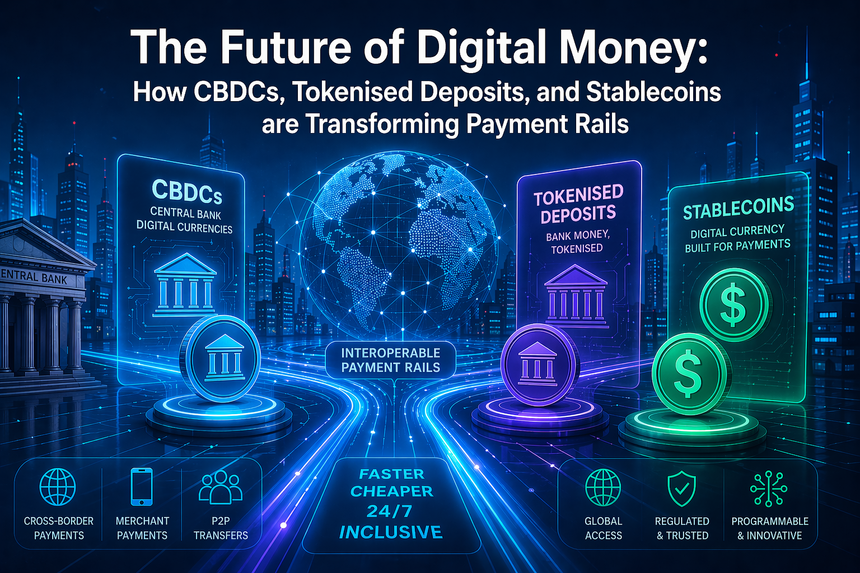

2026 is shaping up to be one of the most progressive and transformative years to date for the development of Digital Money. As a result of the convergence of increased international regulatory guidance, a maturing Distributed Ledger Technology (“DLT”) sector, improved interoperability solutions, and a broader desire to create a more efficient and cost-effective payment ecosystem, there is an increasing push from central banks, financial institutions (including commercial banks) and FinTech firms to release new solutions to enhance existing traditional payment rails.
Historically, financial innovation has been focussed on the front-end for users, with comparatively little progress made in the underlying financial pipelines. Today, however, the developments gradually emerging are not solely targeted at modernising these pipelines, but also at changing money itself and how it operates. In particular, money is becoming programmable through the use of DLT and Smart Contracts, enabling it to operate autonomously. It can execute complex transactions, enforce pre-defined rules and conditions, automatically ensure that compliance protocols such as KYC and AML are satisfied and, where desired, enable conditional spending.
Central Bank Digital Currencies (“CBDCs”), Tokenised Deposits, and Stablecoins.
At the forefront of this development, a unique monetary trio has emerged: CBDCs, Tokenised Deposits, and Stablecoins, and whilst these advancements are connected, they each exhibit very distinct characteristics:-
- CBDCs:
- CBDCs are a digital form of sovereign currency issued directly by a central bank, in both a ‘retail’ form (for the general public) and a ‘wholesale’ form (for financial institutions);
- Tokenised Deposits:
- Tokenised Deposits represent commercial bank money. In essence, a standard deposit is represented as a token on DLT, such as Blockchain Technology, whilst remaining of the bank’s balance sheet; and
- Stablecoins:
- Stablecoins are privately issued Digital Tokens that are designed to track a fiat currency such as USD or GBP.
Each of these three forms of Digital Money are distinct in their structure and issuer and are not competing alternatives. Instead, they are complementary layers of an evolving digital monetary system, each offering something unique on the scale between public and private money:-
- CBDCs sit at the very foundation of the financial plumbing, being sovereign, state-backed, and carrying the trust of the issuing central bank. It acts as the fundamental settlement layer, equivalent in trust to a central bank reserve or physical banknote, but capable of becoming programmable;
- Sitting above the CBDC level are Tokenised Deposits, which simply mirror the traditional framework of commercial banking, but in this new environment. The existing two-tier system, central bank to commercial bank to customer, remains, but the underlying mechanics are improved through the use of Smart Contracts and DLT that allow deposits to operate with logic in ways that have never been possible; and
- Alternatively, Stablecoins represent the private sector's contribution to this traditional financial structure. They operate with no backing of a commercial or central bank but have carved out a distinctive role in the ecosystem, largely in cross-border payments and decentralised finance.
Are the purported benefits of this monetary trio merely speculative or do they have substance?
It is legitimate to ask why there is such substantial attention surrounding these three forms of Digital Money, and whether they simply represent little buzzwords or, in practice, possess the ability to deliver real infrastructural change.
However, based upon the available data, it is evident that whilst this new monetary trio is still emerging, the upward trend is difficult to ignore:-
- CBDCs:
- 134 countries, representing 98% of global GDP, are now exploring or developing CBDCs, up 17% from 2023, with eleven having fully launched a CBDC as of Q1 2025;
- Tokenised Deposits:
- as of 2026, many global systemically important banks offer Tokenised Deposits, including JP Morgan, HSBC, BNP Paribas, and Citi, with around 87% of financial institutions now exploring tokenisation and Tokenised Deposits; and
- Stablecoins:
- Stablecoin transactions grew 72% year-over-year in 2025, reaching around £24 trillion in annual volume, which now rivals the throughput of major card networks such as Visa and Mastercard.
Whilst many banks and FinTech firms are still developing this infrastructure, the benefits that may arise from these forms of Digital Money are not illusory nor speculative, they are demonstrably real:-
- CBDCs:
- by offering an alternative to cash, CBDCs enable central banks to provide the unbanked and underbanked populations more access to financial services, whilst improving transaction efficiency, reducing time and costs. Moreover, it allows central banks to exercise greater control over monetary policy, as the use of DLT and Smart Contracts introduces new mechanisms to monitor economic activity more effectively and, in turn, to manage inflation and interest rates;
- Tokenised Deposits:
- Tokenised Deposits enable traditional deposits to be transferred and settled 24/7/365 on a near-real time basis within the regulated banking network, leveraging the bank’s fiduciary capacity and legal precision with no need for traditional intermediaries. Both retail and commercial clients are able to programme their money to work for them, and, in comparison to Stablecoins, tokenised deposit holders have direct claims on the issuing bank, not a pool of reserve assets; and
- Stablecoins:
Stablecoins have often been referred to as ‘connective tissue’ for payments that operate outside the traditional payment rails and banks’ direct networks. They offer the same speed and always‑on functionality as Tokenised Deposits but particularly excel in cross-border payments and decentralised finance.
What can private parties do to capitalise on this developing financial infrastructure?
Whilst there are a plethora of benefits and real-world applications of the three forms of Digital Money, with some elaborated upon throughout this article, there are numerous gaps that private firms, such as FinTech firms, can capitalise on to help contribute to this new monetary infrastructure:-
- Interoperability:
- These forms of Digital Money largely operate in silos, creating demand for shared standards and interoperability layers that enable seamless value transfer across networks. Firms can build platforms that link tokenised assets with Stablecoins, Tokenised Deposits, or CBDCs to enable real‑time on‑chain settlement;
- USD monopoly over Stablecoins:
- Over 90% of fiat-backed Stablecoins are USD-denominated, dominated by USDT and USDC. This creates a clear opportunity to develop compliant, non‑USD Stablecoins to support more diversified trade, payment, and treasury use cases; and
- Tokenised deposit infrastructure:
- Tokenised Deposits are gaining traction, yet the supporting infrastructure remains underdeveloped. FinTech firms can fill this gap by providing banks with the tools needed to issue, manage, and integrate Tokenised Deposits at scale on DLT.
Why Gibraltar, and more specifically, Hassans?
Whilst the developments of Tokenised Deposits and Stablecoin offerings offer exciting opportunities to form an integral part of the new financial monetary system, numerous legal, regulatory, and operational challenges exist. Understanding these is paramount, and this is precisely where Hassans can help. Hassans is positioned to use its specialised, industry leading FinTech team to assist clients in developing compliant, future-ready Tokenised Deposit Infrastructure and Stablecoin offerings that align with both current and emerging legal requirements.
Hassans is able to deliver expert advice, whilst Gibraltar itself provides a desirable environment to pursue such opportunities. It offers no capital gains, wealth, inheritance, or withholding taxes, a competitive corporate tax rate of just 15%, and targeted tax incentives for high-net-worth Individuals. As an English-speaking British Overseas Territory, Gibraltar combines a radiant Mediterranean lifestyle with infrastructure built to British standards, consistently solid growth, and strong economic indicators. Its business-friendly government maintains minimal red tape, an English-based legal system, and a banking sector supportive of FinTech innovations.
For more insights from our legal experts, please subscribe here.
Money is no longer just being digitised. It is actively becoming programmable.
/Passle/5e2ef0738313d50b64779f79/MediaLibrary/Images/2026-10-20-08-24-23-877-6ad725376b3e1917a7cbc83d.png)
Revolut secures Gibraltar DLT licence to support global crypto expansion.
Global fintech Revolut has been granted a Distributed Ledger Technology (DLT) Provider licence by the Gibraltar Financial Services...
/Passle/5e2ef0738313d50b64779f79/SearchServiceImages/2026-10-20-09-28-29-534-6ad7343d1209e9b330ac8eb4.jpg)
/Passle/5e2ef0738313d50b64779f79/MediaLibrary/Images/2026-10-08-13-44-52-268-6ac79e541204b135b13bff1e.png)
