
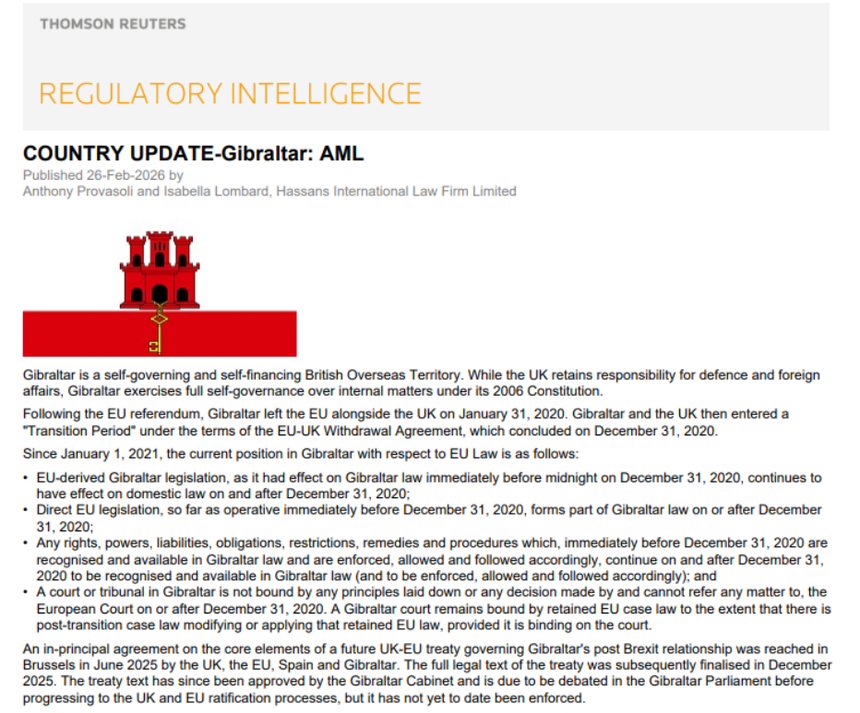


Anthony Provasoli and Isabella Lombard recently provided regulatory intelligence to Thomson Reuters in relation to Gibraltar's anti-money laundering framework.
Gibraltar has significantly strengthened its anti-money laundering (AML) and counter-terrorist financing (CFT) framework in recent years, maintaining a high level of compliance with international standards. Following Brexit, Gibraltar retained EU-derived legislation within its domestic law, while no longer being bound by EU courts.
After previously being placed under increased monitoring by the Financial Action Task Force (FATF), Gibraltar was removed from the “grey list” in 2024 due to successful implementation of required reforms. This has improved its reputation as a reliable and compliant financial centre.
The jurisdiction’s AML regime is primarily governed by the Proceeds of Crime Act 2015 (POCA) and related legislation, incorporating risk-based customer due diligence, beneficial ownership transparency, sanctions screening, and strict reporting obligations. Regulators such as the Gibraltar Financial Services Commission and the Financial Intelligence Unit oversee compliance and enforcement.
Recent updates include stronger powers such as Unexplained Wealth Orders, enhanced sanctions requirements, and expanded regulation of virtual assets. Overall, Gibraltar is positioned as a robust, well-regulated financial jurisdiction aligned with global AML standards.
You can read the full country update here.
For more insights from our legal experts, please subscribe here.
/Passle/5e2ef0738313d50b64779f79/MediaLibrary/Images/2026-10-20-08-24-23-877-6ad725376b3e1917a7cbc83d.png)
Revolut secures Gibraltar DLT licence to support global crypto expansion.
Global fintech Revolut has been granted a Distributed Ledger Technology (DLT) Provider licence by the Gibraltar Financial Services...
/Passle/5e2ef0738313d50b64779f79/MediaLibrary/Images/2026-10-22-13-43-48-368-6ada1314a7658aff68f852d5.png)
/Passle/5e2ef0738313d50b64779f79/SearchServiceImages/2026-10-20-09-28-29-534-6ad7343d1209e9b330ac8eb4.jpg)
